What to include
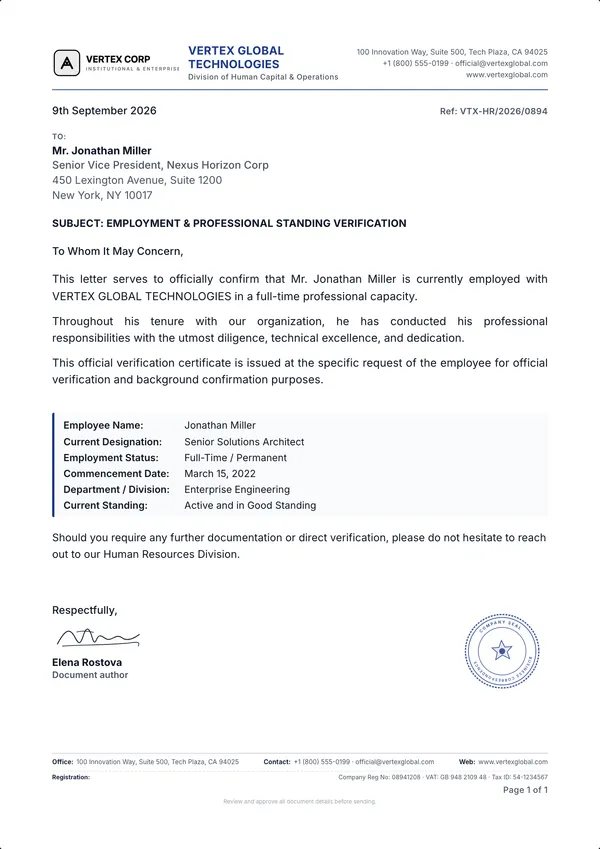
- The employee's full name as it appears on their ID.
- Job title and department.
- Start date and, if applicable, end date.
- Employment status: full-time, part-time, permanent or contract.
- Salary, only when the employee has asked for it or consented.
- The purpose, if the requester needs it (for example a mortgage or visa application).
- The signer's name, title and contact details so the letter can be verified.
Who should sign
Usually someone in HR or a manager authorised to confirm employment details. Printing the letter on official letterhead, adding a company stamp and giving a direct phone number or email for verification all make it harder to forge and easier to trust.
Salary and privacy
Many employers confirm only job title, dates and status by default, and add salary when the employee requests it — for example for a loan or rental application. Getting written consent before sharing personal information is good practice and required in many countries.
Making it accepted first time
- Ask the requester whether they need specific wording or details.
- Use company letterhead with a full address and registration details.
- Date the letter; many organisations only accept letters issued in the last 30–90 days.
- Sign it, add the company stamp if you use one, and provide contact details for verification.
Verification is different from endorsement
A verification letter records employment facts. A recommendation adds the writer's assessment of a person's work. If a recipient only needs confirmation of employment, avoid turning the letter into an endorsement or a prediction of future income.
Factual example: Our records confirm that [employee name] has been employed as [job title] since [start date] and is currently [employment status] as of [issue date]. Please direct verification requests to [authorised business contact].
The employer must verify and approve every statement. A person preparing a draft for HR should leave unconfirmed fields blank and use the employer's request process, rather than signing on its behalf.
Use only the information the recipient needs
- Ask whether the recipient needs dates and status, salary, working hours or a specific form.
- Confirm the employee's permission and your organisation's disclosure policy before sharing personal information.
- Use an authorised contact and the recipient's approved delivery channel. A logo or stamp does not independently verify employment.
Sources and scope
These references support the topics described below. Our worked examples are fictional and are not official forms. Requirements can differ by recipient and jurisdiction.
- GOV.UK — References: your rights
UK guidance that references must be fair and accurate and can be brief. This is not a universal list of verification requirements.
For a correction or a template issue, contact the Letter Studio team. We do not claim legal review or certification of these guides.