Job offer letter checklist
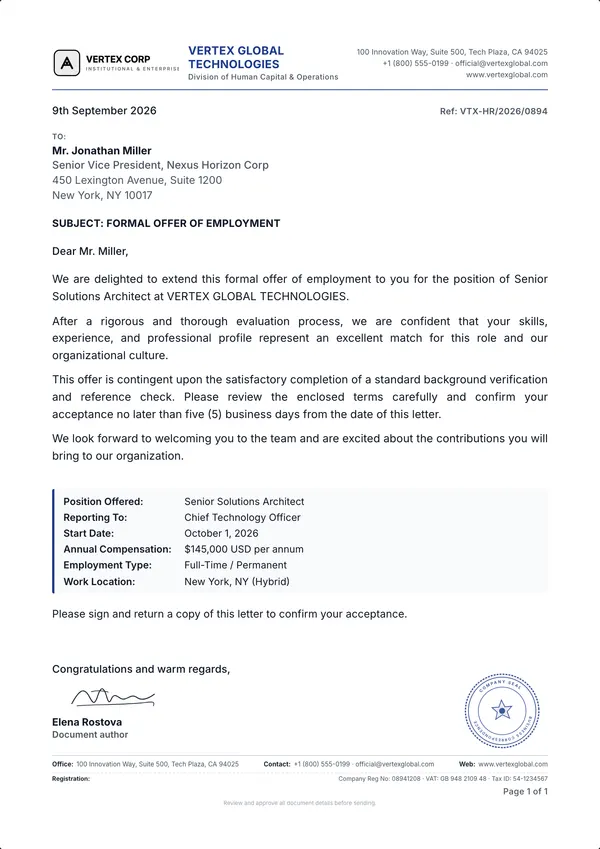
- Job title and department, and who the role reports to.
- Start date and working location (office, hybrid or remote).
- Employment type — full-time, part-time, fixed-term or contract.
- Salary or hourly rate, pay frequency and currency.
- Bonus, commission or equity, if any, with a short description of how it works.
- Key benefits: paid leave, health cover, pension or retirement contributions.
- Working hours and probation period.
- Conditions of the offer: references, background or right-to-work checks.
- A deadline for accepting and how to accept (sign and return, or reply by email).
- Who to contact with questions.
Offer letter vs employment contract
An offer letter summarises the key terms and invites acceptance. A full employment contract sets out detailed terms such as notice periods, confidentiality and termination. In many places a signed offer letter can itself be legally binding, so keep it accurate and consistent with the contract you plan to issue.
Writing it well
- Open warmly: congratulate the candidate and name the role.
- Put the headline terms (title, salary, start date) in a short summary table so they are easy to find.
- Describe benefits and conditions in plain language.
- Set a reasonable acceptance deadline — often three to seven working days.
- End with a welcome and a named contact.
Tip: Use your company letterhead and a real signature. A well-presented offer reassures candidates who may be comparing several offers.
Common mistakes
- Promising things verbally that aren't in the letter — candidates will hold you to both.
- Vague pay descriptions such as "competitive salary".
- Forgetting to say the offer is conditional on checks.
- No deadline, which leaves the role open indefinitely.
Make conditions and compensation unambiguous
A candidate should be able to identify what is being offered and what must happen before the start date. Put confirmed pay and genuine conditions in plain language. If a benefit is governed by a separate policy, name that policy rather than promising an undefined entitlement.
Pay example: Gross annual salary of GBP 42,000, paid monthly through payroll.
Condition example: This offer is conditional on completion of the references described in the attached recruitment notice. Please contact [HR contact] if you have questions before accepting.
These examples illustrate wording only. They do not establish that a particular condition is lawful or appropriate. Check the actual role, approved package and local requirements before using them.
Compare the offer with the final contract
- Compare title, salary, start date, work location and working hours across both documents.
- State how to accept and identify who can answer questions. Use a specific acceptance date that gives the candidate time to review.
- Ask HR to approve the final version. Do not assume that an offer is free of legal consequences until a separate contract is signed.
Sources and scope
These references support the topics described below. Our worked examples are fictional and are not official forms. Requirements can differ by recipient and jurisdiction.
- Acas — Offering someone a job
UK guidance on written offers, conditions and acceptance. Employment obligations differ elsewhere.
For a correction or a template issue, contact the Letter Studio team. We do not claim legal review or certification of these guides.
This guide is general information, not legal advice. Laws differ between countries and situations — for anything with legal consequences, ask a qualified professional to review your letter.